
V-belts have the characteristics of large friction coefficient, small bending loss, high transmission efficiency, and can absorb transmission vibration and noise. Unique straight edge structure, the use of a large number of short fibers, the use of canvas with special processing technology, the use of reverse molding technology, and the use of grinding technology for angles. The use of a large number of short fibers, canvas with special processing technology, reverse molding technology, grinding technology for angles, and long service life. The trimming belt is also called a synchronous belt, which is divided into two types: single-sided toothed belt and double-sided toothed belt.
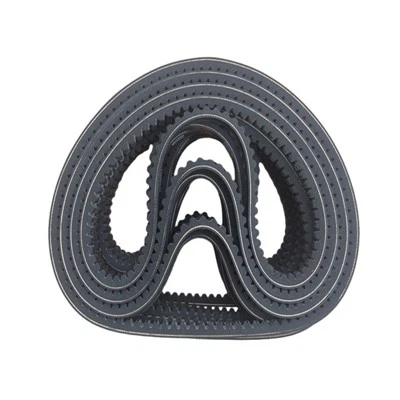

The special engineering design tooth shape increases flexibility, maximizes heat dissipation, and greatly reduces the operating temperature. Strong lateral rigidity prevents the belt from twisting and deforming on the pulley. The bottom layer has a consistent thickness to ensure smooth operation. V-belts can solve problems that occur when a single belt is used, such as vibration, flipping, or slipping, making the drive device that is not running smoothly smoother and reducing costs. The structure is compact. Under the same transmission power, the space occupied by the transmission device is 25% smaller than that of ordinary V-belts. The belt is thin and flexible, suitable for transmission with small pulley diameter and high-speed transmission, up to 40m/s; small vibration, less heat, stable operation. Heat-resistant, oil-resistant, wear-resistant, small elongation in use, long service life.